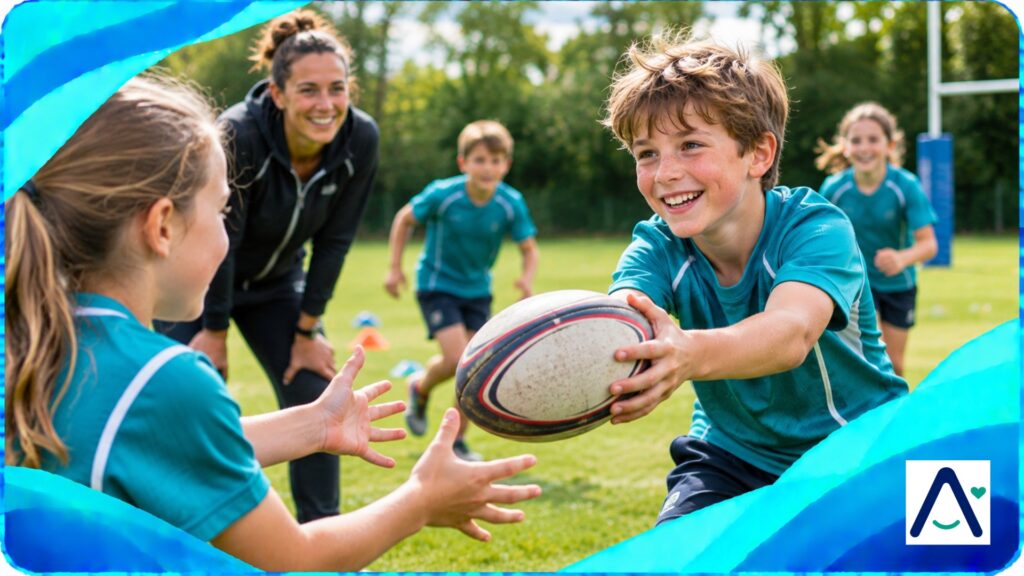
Rugby training designed especially for children with autism, accompanied fitness programmes and sports clubs that open their doors to people with disabilities. Several initiatives show how access to organised sport can change. One project from Hamburg in particular drew attention in 2026. The association Autismus Hamburg was awarded an inclusion prize for its rugby programme for children with autism.
The examples make clear that doing sport together does not depend on participants’ abilities alone. Training routines, sensory load and the experience of coaches also decide whether people with autism find a suitable programme. A recent scientific publication confirms that considerable obstacles to taking part in club sport remain.
Hamburg rugby project receives 15,000 euros for expansion
On 21 January 2026, Autismus Hamburg received the Werner Otto Prize from the Alexander Otto Sports Foundation. With the award, the foundation recognised a rugby programme intended to make it easier for children with autism to access exercise and team sport.
The project began in 2024 in cooperation with the Hamburg Rugby Association and other partners. The children learn basic movements and how to handle the rugby ball. A reliable training framework and sensitive support are meant to give them security.
According to the City of Hamburg, the award-winning programme is aimed in particular at children between eight and twelve. Siblings can also take part. The foundation provided 15,000 euros to secure the existing training group and set up a second one.
The Hamburg rugby club involved now describes an expanded concept for children and young people between six and 16. Training is done with a non-contact variant of rugby. Fixed routines, visual orientation aids, trained supervisors and places to withdraw are meant to take different needs into account.
Families can request a taster session through the project page of the Hamburg rugby club. Because the age ranges of the original award and the club’s current programme differ, parents should clarify the conditions for taking part directly.
The prize shows recognition and support for the project. It does not, however, mean that a scientific study of its long-term effects on the participating children exists.
Other projects open up access to sports clubs
Outside Hamburg, too, programmes are emerging that specifically address people with autism.
In Witten, the German Red Cross developed a fitness project in which interested people could get to know various sport and leisure activities offered by local clubs. Aktion Mensch funded the project with 10,000 euros. The documented funding period ran from 1 June 2025 to 31 May 2026.
Sports science and educational professionals accompanied the activities. The concept was meant in particular to reduce communication barriers and make it easier to get started in existing club programmes.
Whether the project continued after the funding period ended, or whether new club memberships resulted in the long term, is not clear from the published project description.
A further example is the nationwide SportWoche für Alle (Sports Week for All) of the German Disabled Sports Association. From 19 to 26 September 2026, around 200 sports clubs took part with more than 370 participation activities.
The programme ranged from wheelchair basketball and blind football to judo and dance and fitness classes. The aim was to make existing opportunities visible and to encourage additional inclusive training groups.
The Sports Week is aimed generally at people with and without disabilities. The published figures therefore do not show how many people with autism were reached. Nor were all of the more than 370 activities newly created.
New research still shows considerable barriers
A specialist paper published in the Bundesgesundheitsblatt on 8 October 2026 examines which conditions make it harder for people with disabilities to take part in organised sport.
The authors, Sina Eghbalpour and Pauline Reifferscheidt, describe, among other things, a lack of accessible entrances, insufficient information, difficulties with mobility and a lack of assistance options. A lack of experience among coaches with different support needs can also make access harder.
The paper takes up earlier studies and stresses that sports clubs, families, schools and social services should work together more closely. The publication is not a new effectiveness study of sports programmes for people with autism.
Further aspects can matter for people with autism. A high noise level in the sports hall, frequently changing training routines or unclear social expectations can make taking part stressful. Others value the shared training and the regular contact.
What is decisive, therefore, is not that a programme includes as many special measures as possible. Rather, those responsible should find out together with the participants which conditions they need.
Families can ask for suitable support in club sport
Anyone looking for a sports programme for a child with autism or for themselves should first consider personal interests. Not everyone wants to play team sport. Others prefer swimming, martial arts, athletics or exercise without competition.
It helps to talk to the club before a trial session. This can clarify, for example, group size, noise level, fixed contact persons, places to withdraw and how a training session runs.
Parents should also ask whether a familiar companion may take part at first and how the club deals with overload or short-notice breaks.
Our knowledge article on leisure activities and special interests in autism explains how important personal interests and reliable conditions can be.
If a person needs support because of their disability in order to take part in a sports programme, assistance services under integration assistance (Eingliederungshilfe) may also be an option under certain conditions.
Under section 78 of Book IX of the Social Code (SGB IX), assistance services can expressly include leisure activities, including sport. This does not give rise to a general entitlement to have a club membership funded. The individual conditions and the support need that has been established are decisive. Our article on integration assistance for autism offers further information.
The Hamburg rugby project and other initiatives show that clubs can adapt their programmes to different needs. Whether this leads to lasting better opportunities for participation, however, has yet to be shown in everyday club life.
For people with autism, what matters above all is that they can choose between suitable sports programmes and that taking part does not fail because of avoidable organisational or social barriers.
Sources
Free and Hanseatic City of Hamburg, 21 January 2026. Werner Otto Prize 2026 for rugby programme of Autismus Hamburg.
Hamburg Rugby Association. Rugby project for children and young people with autism.
Hamburg Rugby Club. Autism and rugby in Hamburg’s Stadtpark.
Aktion Mensch. Inclusive fitness for people on the autism spectrum in Witten.
German Disabled Sports Association, 1 October 2026. SportWoche für Alle 2026. Together for inclusion in practice.
Eghbalpour, S. and Reifferscheidt, P., 2026. Promoting participation in sports clubs. Sport- and movement-oriented social work with people with impairments. Bundesgesundheitsblatt, vol. 69, pp. 1281–1286.
Federal Ministry of Justice and Consumer Protection. Section 78 SGB IX – assistance services and section 113 SGB IX – services for social participation.
Found a mistake?
If something is factually wrong, out of date or unclear, let us know. You do not have to give any personal details.