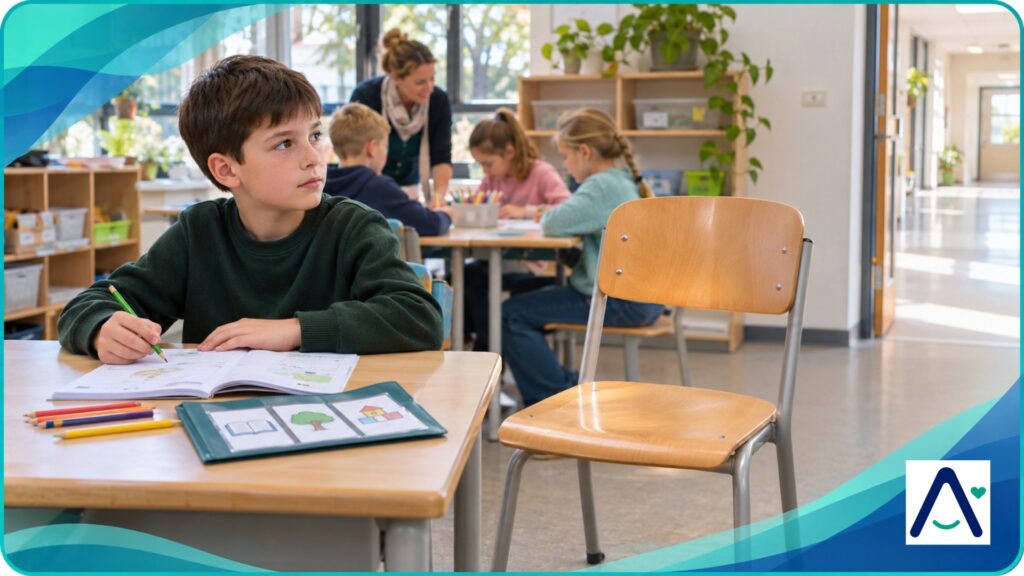
When children cannot go to school for weeks or months, they often lose more than lesson content. Contact with friends and teachers can also suffer. Telepresence avatars are meant to maintain that connection. The small robots stand in for the child in the classroom while the sick child takes part in lessons from home or from hospital.
The technology is already being used in several German states. Schools can in some cases borrow the devices free of charge. Which conditions have to be met, who bears the costs and which data protection rules apply, however, depends on the state. For children with autism, individual adjustments at school can also be important.
A small robot makes it possible to take part in lessons
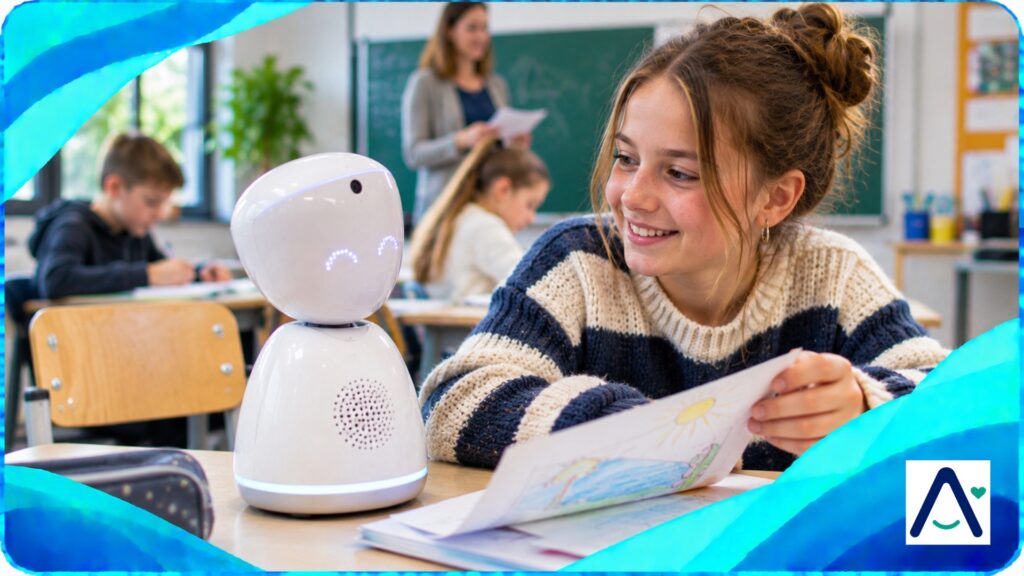
A telepresence avatar has a camera, a microphone and a loudspeaker. The sick child controls the device with a tablet and can follow lessons in real time, ask questions or talk to other pupils.
With the widely used AV1 model, the robot’s head can be moved. Using light signals, the child can show whether they want to speak up or would rather follow the lesson quietly. Classmates can also take the avatar along to other rooms or to break.
The decisive difference from an ordinary video conference lies in being part of everyday school life. The avatar has a fixed place in the class and can also make a connection possible during group work or informal conversations.
However, the technology is not suitable for every sick child. Anyone who can concentrate for only a short time because of an illness may need shorter lesson times and regular breaks. The provision of work materials must also be agreed with the school.
In March 2025, the Conference of Education Ministers stressed that sick pupils need social participation as well as suitable learning opportunities. Cooperation between school, family and medical professionals plays an important role in this.
Nuremberg and other municipalities already lend school avatars
The city of Nuremberg provides a concrete example. Three telepresence robots were first put into use there from December 2024. According to the city, all three devices were on loan in July 2025. They supported, among others, children with serious illnesses such as cancer or pronounced states of exhaustion.
Two more avatars were added in October 2025. A foundation provided 13,176 euros for this. The additional devices are made available to schools as loan models for three years each.
Rhineland-Palatinate also has a corresponding programme. Schools can borrow telepresence robots through regional competence centres of the state pedagogical institute. One condition there is, among others, that the school supervisory and service directorate has approved home or hospital teaching.
In Wiesbaden, the city media centre also provides school avatars. Schools can borrow the devices free of charge and also receive technical support and information materials.
The examples show that use has long gone beyond individual trials. They do not, however, show nationwide provision. No uniform nationwide figures exist on how many children regularly take part in lessons with an avatar.
Funding and data protection remain important hurdles
Anyone who wants to use an avatar for their child should first contact the head teacher. There it can be clarified whether suitable devices are available or can be borrowed through a school authority or a media centre.
Funding differs by region. In Nuremberg, the first devices were bought with municipal funds. Further avatars came through foundation funding. In Wiesbaden, free loans are made through the media centre.
For longer-term needs, individual funding as an aid may in some circumstances also be examined. However, this gives rise to no general entitlement to have the costs covered by the health insurance fund. The specific need and the legal requirements of the funding body concerned are decisive.
In addition, schools must observe data protection requirements. The avatar’s camera transmits image and sound from the classroom. Other children and teachers are affected by this too.
The State Media Centre of Baden-Württemberg explains that, under the rules there, special avatar teaching requires the consent of the people affected in the classroom. This consent applies for one school year at a time.
It must also be ensured that only authorised people can take part in the transmission. The school must check the technology used and the data processing. Recordings of lessons require a separate legal basis.
The rules differ between the German states. Baden-Württemberg also expressly makes clear that there is no individual entitlement to avatar teaching.
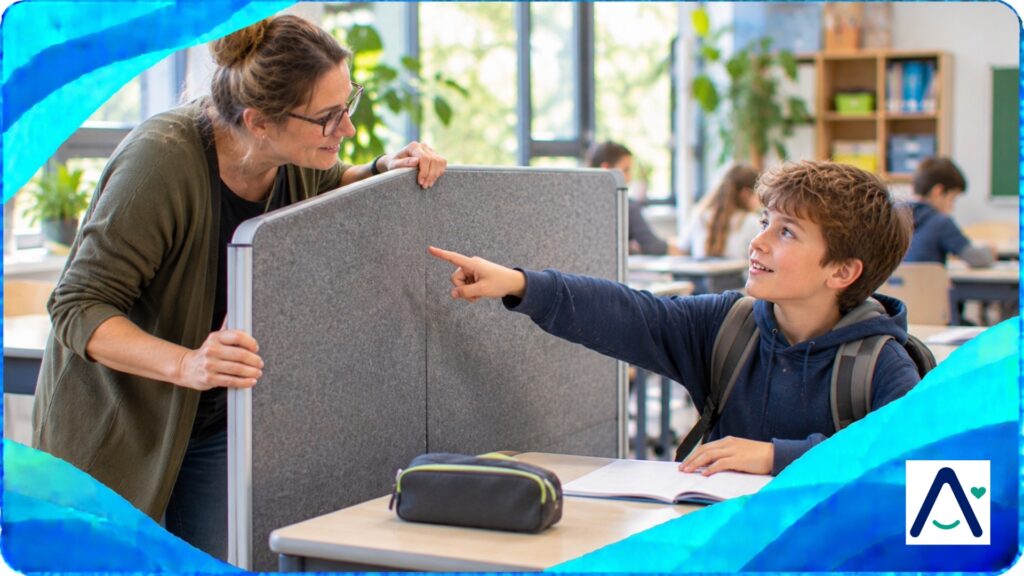
For children with autism, further adjustments at school are important
Telepresence technology can also be of interest to children with autism in individual cases. If an additional physical or mental illness prevents school attendance over a longer period, an avatar could help to maintain contact with the class.
An autism diagnosis alone, however, does not give rise to an entitlement to a school avatar. Nor is the technology suitable as a blanket solution for school avoidance.
If a child cannot attend school because of bullying, strong sensory load or stressful social situations, for example, these causes must be investigated and addressed. A digital connection to an unchanged school environment can otherwise trigger the same stress.
Our knowledge article on school avoidance and school absenteeism in autism explains which causes can lie behind such difficulties.
Besides the possible use of an avatar, families should therefore check which other adjustments could make school life easier. These include, for example, extra processing time, a lower-stimulus room for assessments or individually agreed breaks.
The free Nachteilsausgleich assistant from Autismus Wissen (an assistant for disadvantage compensation at school) offers support. The interactive tool helps parents, pupils and professionals to find suitable measures based on individual support needs. It takes into account the school law of the respective German state and helps to prepare a corresponding request in writing.
A distinction has to be drawn between disadvantage compensation and telepresence teaching. Disadvantage compensation changes the conditions under which a school performance is delivered, without lowering the subject requirements. The assistant can help classify such adjustments but cannot establish an entitlement to an avatar. The responsible school bodies decide on specific measures under the applicable rules.
For families of children with autism, it can make sense to combine several support options. Our article on cooperation between parents and school explains how support measures and responsibilities can be agreed in writing.
Parents should talk to the school early
A longer absence from school because of illness should be discussed with the school as early as possible. The first question is which kind of participation the child can manage health-wise and which educational provision is legally foreseen.
The school can then examine whether home or hospital teaching, a telepresence avatar or other forms of support come into question. If an individual support plan already exists, the professionals involved should clarify whether it needs to be adjusted.
The possible return to in-person lessons should also be considered. An avatar can maintain contact with the class but does not replace longer-term planning for the return. Realistic lesson times, understandable agreements and involving the child in decisions are particularly important.
Telepresence avatars open up new possibilities for participation in school for pupils with long-term illness. What remains decisive, however, is that the technology does not become an end in itself. It must be guided by the health, abilities and needs of the individual child.
Sources
City of Nuremberg, 22 October 2025. More participation for pupils with long-term illness through two further school avatars.
City of Nuremberg, 11 July 2025. Telepresence robots provide support in long-term illness.
Pedagogical State Institute of Rhineland-Palatinate. Participation of sick pupils through telepresence robots.
State Media Centre of Baden-Württemberg. Telepresence robots and avatars in lessons. Information on legal bases, data protection and school requirements.
City of Wiesbaden. School avatars in the media centre’s equipment loan service.
Conference of Education Ministers, 21 March 2025. Recommendations on schooling, advice and support for sick pupils.
Found a mistake?
If something is factually wrong, out of date or unclear, let us know. You do not have to give any personal details.