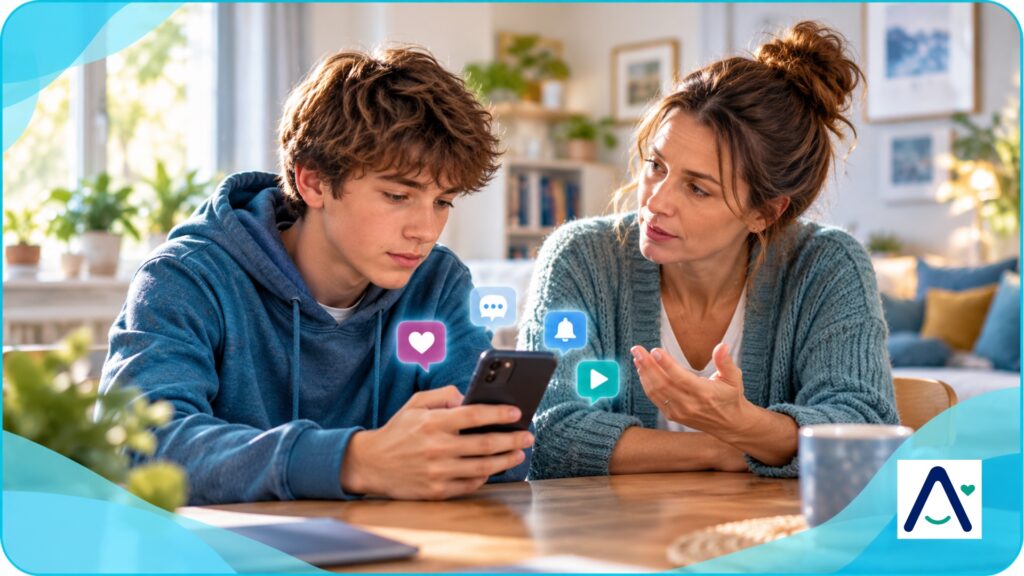
For some children with autism, a chat is easier than a conversation in the playground. They can reply in peace, exchange ideas about their interests and keep up contacts without having to process facial expressions, noise and group dynamics at the same time. But access to social networks could change in future. The German federal government is planning a general ban for children under 13. This raises the question for families with autism, too, of how protection and digital participation fit together.
Federal government plans age limit for social networks
On 14 October 2026, the Federal Cabinet adopted key points (Eckpunkte) for stricter child and youth media protection. Germany wants to push for an age limit at European level. Until an EU rule applies, a national interim solution is to be created.
According to the plans, children under 13 are in principle not to get access to social networks. Demonstrably child-appropriate services are to be exempt. For young people between 13 and 18, graduated restrictions are planned.
Platforms are also to be more strongly obliged to protect children from addictive features and problematic recommendations. Algorithmic recommendation systems are to be deactivated by default. A digital identity solution is planned for age verification from 2027.
The ban does not apply yet. The Cabinet has adopted political key points, but not a finished law. When new rules will apply and which services will fall under them in detail is open.
This is not meant as a mobile phone ban
The age limit under discussion concerns social networks. It does not mean that children under 13 will in future generally no longer be allowed to use a smartphone, online games or digital learning services. Child-appropriate internet services are expressly to be developed further, according to the government.
For messengers, video services and games too, the later classification depends on the specific legal definition. Anyone who claims today that all chats or online games will be banned is anticipating the decision.
Digital contact can be important for children with autism
Written messages can be read and answered at one’s own pace. Shared interests give conversations a clear direction. Some people with autism experience this kind of communication as less stressful than spontaneous encounters in large groups.
A British study published in September 2026 analysed responses from 144 people with autism about their experiences in interest-based online groups. The participants reported both a sense of belonging and a fear of being misunderstood. The study provides insights into personal experiences but does not prove that social networks are helpful for all children with autism. The results cannot be transferred directly to children under 13 in Germany.
Some children and young people find like-minded people more easily online. Others hardly use such services or prefer encounters outside the internet. Which forms of communication can provide relief is explained in our knowledge article on communication in everyday life.
The risks online remain serious
Cyberbullying, unwanted contact, distressing content and endless scrolling can harm children. An age limit is meant to curb such dangers. Even so, it would be wrong to conclude that digital services are fundamentally problematic for people with autism.
A scientific review from 2025 found, in 46 studies with a total of 42,274 participants, a statistical association between autism, or more pronounced autistic traits, and problematic internet use. A second analysis of 15 studies, by contrast, showed lower use of social media in the groups examined. The results do not prove a cause and make no prediction for an individual child.
The German Society for Child and Adolescent Psychiatry stressed in February 2026 that children need both protection and the opportunity for digital participation. An age limit alone therefore does not answer all questions.
Exceptions for children with autism still unclear
The key points published so far do not set out any special exemption rule for children with autism. Only exceptions for demonstrably child-appropriate services are expressly provided for. Whether and how the additional needs of children with disabilities will be taken into account in implementation remains open.
An exception based solely on a diagnosis would not automatically be the right solution for every family. What matters is that digital protection measures can be implemented well, are accessible and do not unnecessarily cut children off from important contacts. The perspectives of children with disabilities should therefore feed into the further design.
What parents can do now
For families, nothing changes directly for the time being as a result of the Cabinet decision. It still makes sense to talk with children about which apps they use, which contacts do them good and where they feel uncomfortable. Especially in the case of unwanted messages, it should be clear whom they can turn to.
Privacy settings set up together, rules for contact with strangers and reliable breaks are helpful. Screen time is not the only thing that counts. Sleep, recovery, exercise and the question of whether the child can still manage their media use well are also important.
If an online group fulfils an important social function, parents should look for safe alternatives together with the child. Further tips are given in our article on Screen time, gaming and the internet (in German). Ways of pursuing shared interests outside social networks are shown in the article Leisure and interests in autism.
Protection and participation belong together
The planned age limit would also affect children with autism. It is meant to reduce the dangers of digital platforms, but at the same time raises questions about self-determined communication and accessible alternatives.
On the basis of the key points paper, parents do not have to switch off any services immediately. What will be decisive is which rules are actually passed and whether they take different needs into account. Effective youth protection should limit risks without unnecessarily restricting social participation.
Sources
Federal Ministry of Education, Family Affairs, Senior Citizens, Women and Youth. Key points on child and youth media protection. 14 October 2026 (in German).
German Society for Child and Adolescent Psychiatry. Use of digital media and mental health. 19 February 2026 (in German).
Koteyko, N. et al. The neurotypical listening subject in autistic young people’s accounts of participation in online affinity spaces. Language in Society. 30 September 2026.
Muris, P. et al. Caught in the Web of the Net? Part I. Clinical Child and Family Psychology Review. 23 April 2025.
Found a mistake?
If something is factually wrong, out of date or unclear, let us know. You do not have to give any personal details.