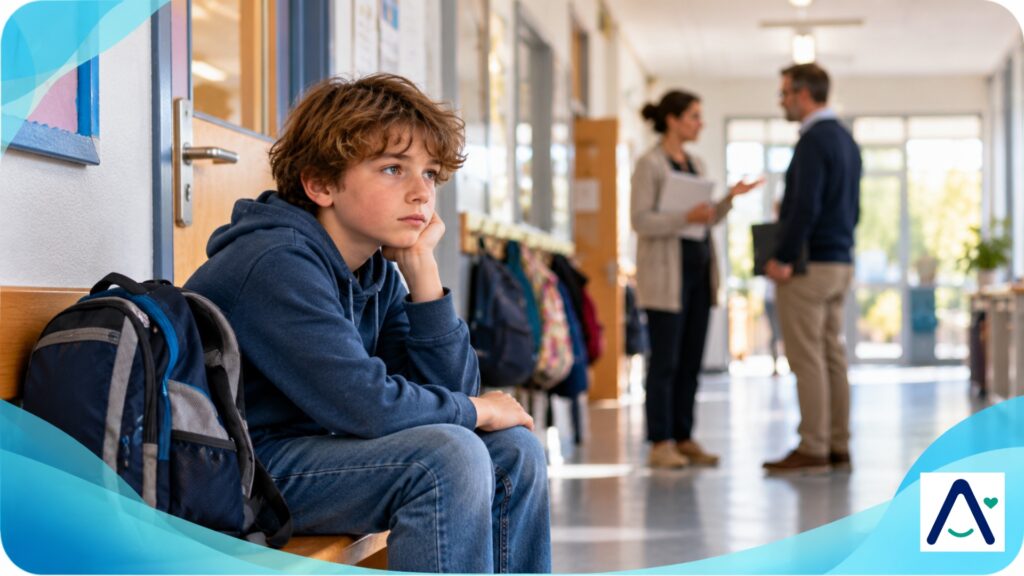
Overcrowded classrooms, missing teachers and more and more children with particular support needs. At some schools in Germany the situation is becoming increasingly difficult. This is shown especially clearly at special education and counselling centres in Baden-Württemberg, where rising pupil numbers are now causing considerable space problems.
At the same time, a scientific commission of the Standing Conference of the Ministers of Education and Cultural Affairs gives the German education system a critical assessment. Autistic children often do not find learning conditions that match their individual needs. The decisive question is therefore not only where these children should be taught, but what schools have to change so that education and participation really succeed.
Special schools are increasingly reaching their limits
A report by the Tagesschau of 24 September 2026 describes considerable bottlenecks at special schools in the district of Tübingen. At the Lindenschule in Rottenburg, an additional classroom is already housed in a container. The attached special-needs kindergarten had to move to another building to make room for more school classes. At the same time, class sizes were raised from six to up to eight children.
In Baden-Württemberg, the number of pupils at special education and counselling centres rose from around 52,000 in 2020 to about 57,000 in 2026. These figures cover all areas of special educational support and not only autistic children. According to the district of Tübingen, however, increasing numbers of autistic children and children with ADHD are also being looked after at the institutions.
The development makes a structural problem visible. When more children depend on particular support, but rooms and qualified staff are lacking at the same time, individual learning needs come under pressure. This affects not only special schools but equally mainstream schools that teach children with different prerequisites together.
More diagnoses do not necessarily mean more autism
The scientific context is important. In its opinion of 18 June 2026, the Standing Scientific Commission of the Standing Conference of the Ministers of Education and Cultural Affairs reports a clear rise in documented autism diagnoses. As possible causes it names, among other things, improved diagnostics, changed diagnostic criteria and increased awareness of autism.
Whether autism actually occurs more often than before cannot be concluded from this. The commission expressly points out that a corresponding rise in the actual frequency has not been demonstrated so far. In addition, there are no nationally representative data in Germany on how many pupils with autism attend which type of school.
This creates a problem for education planning. If schools and school authorities do not know enough about which support needs exist, staff, rooms and support services can only be planned to meet demand to a limited extent. A reliable data basis would therefore be important in order to align school provision with actual needs in the long term.
Scientists see considerable deficits in participation at school
The scientific commission concludes that, despite existing support services, autistic children and young people often do not find suitable learning conditions. It is particularly critical of the large differences between federal states, regions and individual schools. The body also considers the preparation of many teachers for autism-specific needs to be inadequate.
This is not only about academic performance. Autistic children can suffer from stressful sensory impressions, unpredictable routines or difficulties in social communication. There may also be experiences of bullying and exclusion. If such strains persist over a longer period, regular participation in lessons can become considerably more difficult.
The commission therefore recommends a more systematic consideration of autism across the whole education system. This includes better data, clear legal frameworks, individual support planning and mandatory training for teachers and educational professionals. Responsibility for successful participation at school must not be left to the children affected and their families alone.
What schools would have to change in concrete terms
An autism-sensitive school does not need a completely different form of teaching for every child. Many changes can already be implemented within existing class structures. These include understandable task instructions, predictable daily routines, visualised timetables and early announcement of changes.
The design of the space is also important. Places to withdraw to, less stressful noise levels and clearly organised workplaces can help individual children concentrate better on lessons. Which adjustments make sense, however, has to be clarified individually. Not every autistic child experiences the same difficulties or needs the same support.
The scientific commission recommends a multi-level concept. First, as many pupils as possible should benefit from a low-barrier learning environment. In addition, individual adjustments to teaching and extra support services should be added where needed. These can include augmentative and alternative communication, special educational measures or temporary support in smaller groups.
A further focus is the training of staff. Teachers need not only information about diagnostic features but also practical knowledge about designing lessons, communication and dealing with situations of overload. Cooperation between different educational professionals should be strengthened so that support measures do not take place in isolation from one another.
School assistance must not replace suitable teaching conditions
For some autistic children, a school assistant (Schulbegleitung) is an important precondition for taking part in lessons. It can help, for example, with orientation, communication or coping with stressful situations. A school assistant does not, however, take over the teacher’s tasks and does not replace special educational support.
For precisely this reason it is not enough to hand responsibility for successful inclusion to a single assistant. The school remains responsible for teaching, the organisation of learning and the design of the school environment. What matters is coordinated cooperation between teachers, the school assistant, parents and, where appropriate, other professionals.
Reasonable adjustments in assessment (Nachteilsausgleich) can also play an important role. Depending on individual needs and the rules of the respective federal state, options include, for example, adapted examination conditions or extra working time. The concrete arrangements have to be examined case by case. The aim is to compensate for disadvantages caused by disability without losing sight of the subject-related learning goals.
What parents can do now
If a child regularly comes home from school overwhelmed, avoids lessons or repeatedly experiences stressful situations, parents should seek a conversation with the school early. It helps to describe the difficulties as concretely as possible. In doing so, it should be noted not only what the child finds hard, but also under what conditions they can learn well.
Agreements made together should be documented in writing and reviewed regularly. These include concrete support measures, the people responsible and a date for the next conversation. Depending on the federal state, school counselling services, special educational services or the relevant autism officers can also be involved.
It is also important to involve the child themselves, in line with their communication options. They can often best convey which situations are stressful and which changes would help. The child’s perspective should therefore be taken into account in decisions at school, instead of talking only about their difficulties.
Inclusion is decided by learning conditions
The reports on overloaded special schools and the scientific opinion show two sides of the same problem. On the one hand, rooms and professionals are lacking at some sites. On the other hand, there are still considerable differences in how well schools are prepared for the needs of autistic children.
More school places alone will not solve this problem. Equally necessary are reliable support structures, appropriately qualified staff and teaching conditions that take different learning prerequisites into account. For this, schools, school authorities and education policy have to take responsibility together.
Whether an autistic child attends a mainstream school or a special school does not yet answer the question of successful education. What matters is whether they can learn, develop and take part in school life there. A school is not inclusive simply because children with different prerequisites sit together in one classroom.
Sources
Standing Scientific Commission of the Standing Conference of the Ministers of Education and Cultural Affairs (18 June 2026). Supporting autistic children and young people at school (in German). Scientific opinion with five recommendations.
Tagesschau and SWR (24 September 2026). Autism diagnoses are rising. Special schools are bursting at the seams (in German). Report on the situation in Baden-Württemberg.
Ministry of Education and Cultural Affairs of Baden-Württemberg. Autism at school (in German). Specialist information on autism and school support services.
Found a mistake?
If something is factually wrong, out of date or unclear, let us know. You do not have to give any personal details.