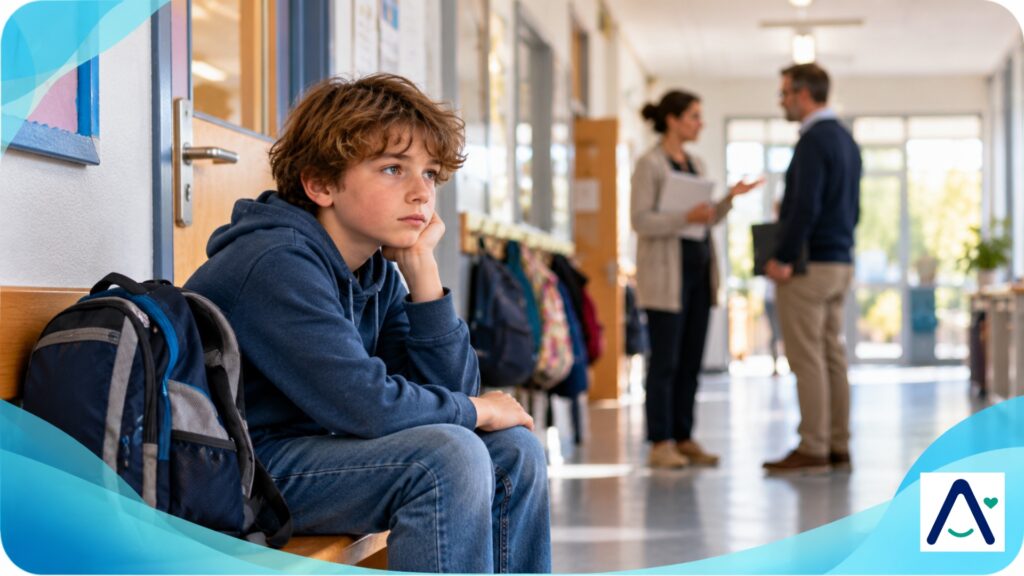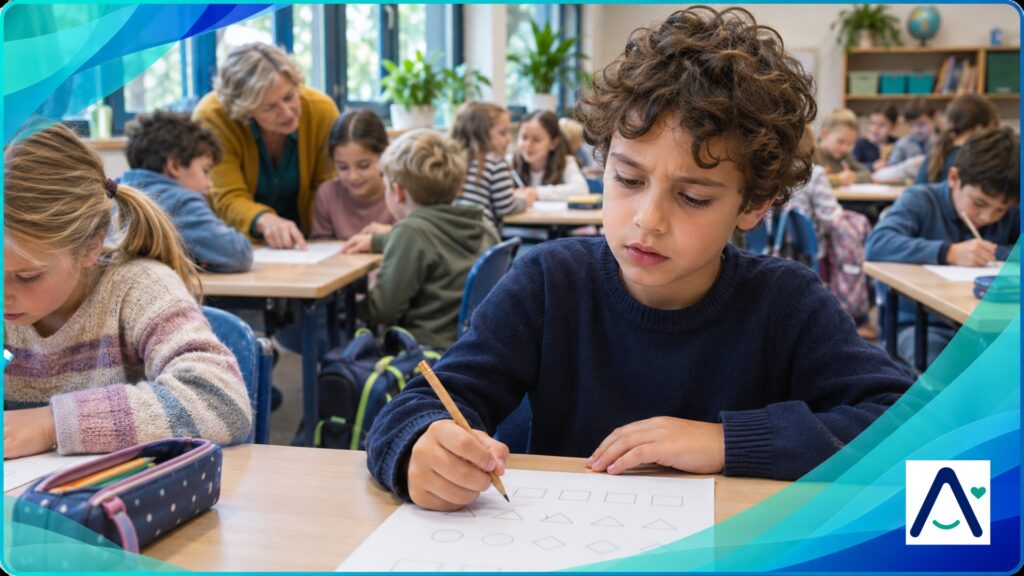
At school the child is quiet, joins in and hardly stands out. The teacher reports a good day. But at home a small question sometimes suffices, and suddenly there are tears, anger or complete withdrawal. For some families with an autistic child, this contrast is part of everyday life. A study published in 2026 shows how much effort can lie behind a seemingly inconspicuous school day.
Researchers at Newcastle University surveyed 136 children aged between eight and 14 about their experiences of autism. Almost half reported hiding autistic traits. Many described school as a stressful place, while they felt safer at home and could show their needs more openly. The results help to understand why a child can seem completely different in different environments.
Why autistic children often seem inconspicuous at school
Numerous rules apply in the classroom. Children are expected to sit still, listen, start tasks, work with others and respond to spontaneous changes. Add to that sounds, light, social expectations and the constant presence of other people.
For some autistic children, this demands considerable effort. They try to control their reactions, not to show uncertainty or to imitate the behaviour of others. Such conscious or unconscious adaptation strategies are called masking.
A child can, for example, make eye contact even though it is uncomfortable. Another suppresses movements that normally help them regulate, or does not say that the noise in the classroom is almost unbearable.
If this effort is not recognisable from the outside, the impression may arise that the child is coping without problems. Their actual strain remains invisible.
Study shows how often children hide their autism
The Newcastle University study, published in March 2026, gave autistic children themselves the opportunity to report on their experiences. A total of 136 children from the United Kingdom took part. According to the study, 86 percent had a formal autism diagnosis; the other children identified themselves as autistic.
Of the children surveyed, 45.1 percent said they masked their autism at least at times. It became particularly clear how strongly trust in other people influenced whether the children could communicate their needs.
With family members, 62.4 percent felt fairly or very comfortable talking about their autism. With people outside the family, it was only 16.5 percent.
The research team describes how many children feared not being understood, being rejected or being excluded. Some reported exhaustion and loneliness because in certain situations they tried to appear different.
The study is not a representative survey of all autistic children. It does show impressively, however, how differently one and the same child can experience themselves depending on their environment.
Why the strain sometimes only becomes visible at home
After a tiring school day, numerous external demands fall away. The child no longer has to follow the rules of the classroom, does not have to hold conversations with classmates and may pay less attention to their body language.
At the same time, the strains of the day do not disappear immediately. Exhaustion, built-up tension or difficulty processing many impressions can continue.
In some children this shows in crying, irritability or intense emotional reactions. Others suddenly speak hardly at all, withdraw or need complete quiet for a long time.
In the English-speaking world, this pattern is often called after-school restraint collapse. It refers to a breakdown of the self-control that was maintained beforehand, after the school day.
The term is not a medical diagnosis in its own right. It describes a possible experience whose causes have to be clarified in the individual case.
A second study shows how strongly girls adapt
A study of 31 autistic girls at secondary schools also provides important findings. About two thirds of the participants reported using masking for most or all of the school day.
The girls adapted especially often in regular lessons and in contact with classmates they were less familiar with. At home or with neurodivergent friends, they showed this behaviour less often.
Many described the exhaustion linked to constant adaptation as particularly stressful. At the same time, masking could help them cope with social situations or avoid unwanted attention.
The study thus shows why an outwardly successful school day does not automatically mean that a child feels well. Because of the small sample, however, the results cannot be transferred to all girls or to boys with autism.
When the child cries or gets angry after school
For parents, it is sometimes hard to understand why a seemingly harmless request triggers a strong reaction. The child is supposed to put their shoes away, start homework or say how their day was. Suddenly a conflict arises.
The cause does not have to lie in this single request. Perhaps the child is already exhausted, hungry, sensory overloaded or tense from stressful experiences at school.
A further demand can then be too much. Even so, not every outburst of anger should automatically be classed as an autistic meltdown.
Pain, sleep problems, bullying, anxiety, family strains or other illnesses can also influence behaviour. What matters is to recognise recurring patterns and to examine possible causes seriously.
What role strong sensory impressions can play is explained in our knowledge article on sensory overload in autism.
What parents can change immediately after school
Some children are helped when the first time after school is made as predictable as possible. Instead of asking questions or demanding homework straight away, a quiet transition phase can make sense at first.
The child could eat something, retreat to their room, listen to music or do a familiar activity. Others want to move or spend time with a familiar person.
It is important not to assume automatically that every child needs quiet or complete withdrawal. What matters is which form of recovery actually helps them.
Parents can think with their child about whether conversations about the school day are better held at a later time. Sometimes needs can also be expressed more easily in writing, with pictures or through agreed signals.
In the case of intense reactions, safety should be established first and pressure reduced. Long explanations or discussions are often of little help during acute overload.
Why school should take behaviour at home seriously
When parents report regular meltdowns after school, they sometimes hear that no difficulties are observed at school at all.
Both perceptions can be true. The child can actually be quiet in lessons and still put in considerable effort to maintain this state.
A scientific review on school anxiety in autistic children published in 2026 describes various stress factors. These include social expectations, pressure to perform, sensory overwhelming environments and unpredictable changes.
The research team points out that support should not start only with the child’s behaviour. The conditions under which the strain arises are just as important.
Teachers and parents should therefore look together at which demands during the school day take particularly much energy. The child’s own perspective is also decisive.
Which changes at school can help
A lower-stimulus workplace, reliable breaks or an accessible place to withdraw to can help some children. Others benefit from written instructions, announced changes or a fixed contact person.
Social situations also deserve attention. Breaks, group work and moving between classrooms can be more stressful than the actual learning tasks suggest.
It can therefore make sense to look not only at academic performance. The questions of how exhausted a child comes home, whether they feel safe and how much effort taking part in lessons costs are also important.
Concrete agreements should be documented and reviewed regularly. Our knowledge article on cooperation between parents and school explains how families and teachers can proceed.
When parents should look more closely
Occasional exhaustion after school is not unusual. If a child regularly comes home under heavy strain, loses their previous interests or increasingly develops difficulties with attending school, this should be taken seriously.
Parents should be especially attentive when sleep problems, persistent anxiety, physical complaints or self-injurious behaviour are added.
A joint assessment with the school and suitable medical or psychological professionals may then be necessary. The aim should not be for the child to hide their strain even better. What matters is to understand the causes and to find suitable support.
If school avoidance is increasing, our article on school avoidance in autism offers further orientation.
What research cannot yet answer
The studies show that masking, school strain and different behaviours at home and at school can be connected. They do not allow a reliable statement, however, on how often autistic children experience an emotional breakdown after school.
It is also not scientifically established whether masking is the decisive cause in every corresponding case. Children can be exhausted or irritable after school for different reasons.
The new research therefore argues not for a simple explanation but for a closer look at the everyday life of the children concerned.
A quiet child is not automatically an unburdened child
When an autistic child seems inconspicuous at school, this can mean many things. Perhaps they feel comfortable there and receive suitable support. But perhaps they are also investing considerable energy to meet expectations and not let overload become visible.
Parents and teachers should therefore not judge solely by how quiet a child is or how reliably they complete tasks. How they feel while doing so is just as important.
The British studies show how valuable it is to listen to children themselves. Their experiences can help to recognise strain before it shows in lasting exhaustion, withdrawal or school avoidance.
A successful school day should not be measured only by there having been no conflicts. What also matters is whether the child receives enough support and still has energy for their own life after school.
Sources
Mullally, S. L. et al. Growing-up autistic, Sharing autistic children’s experiences and insights. Autism, 26 March 2026.
Goscicki, B. L. et al. Autistic Girls’ Social Camouflaging in Inclusive High School Settings. Journal of Autism and Developmental Disorders, published online on 10 January 2025, journal issue 2026.
Atkinson, E. et al. School Belonging, Camouflaging, and Anxiety in Autistic Students. Journal of Autism and Developmental Disorders, published online on 8 January 2025, journal issue 2026.
Fisher, E. et al. School Anxiety Experienced by Autistic Children, A Systematic Review of Contributing Factors. School Mental Health, 21 March 2026.
National Autistic Society. Masking in autism and its possible effects. Specialist information.
Understood.org. Restraint collapse, Why kids fall apart after school. Professionally reviewed parents’ guide, updated on 5 August 2026.
Found a mistake?
If something is factually wrong, out of date or unclear, let us know. You do not have to give any personal details.