
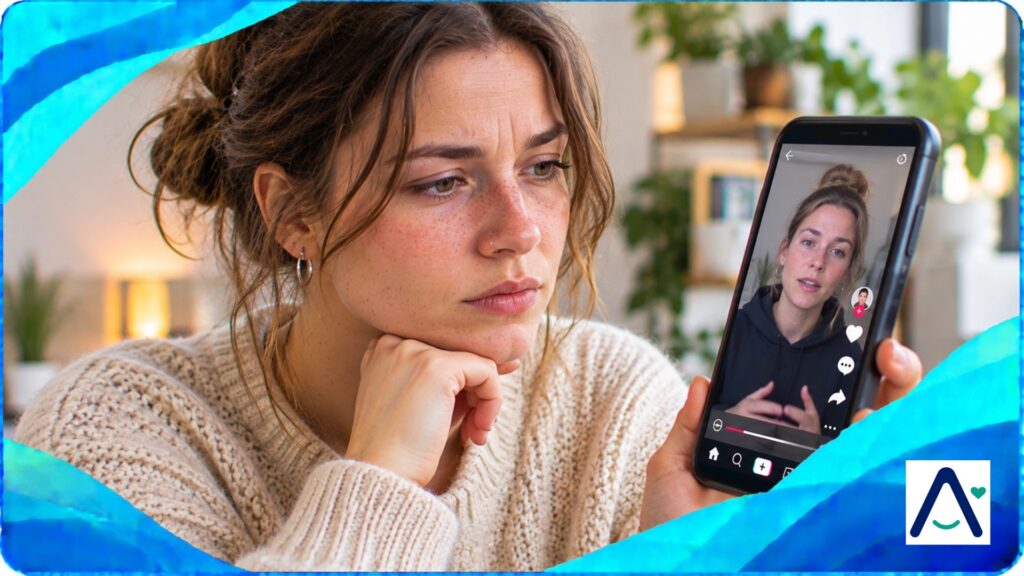
For many young people, TikTok has long been more than an entertainment platform. In short videos, people talk about personal experiences with autism, explain supposed symptoms or discuss self-diagnosis. But how reliable is such information? A study from the University of Montréal published in October 2026 shows considerable quality problems. The researchers found misleading statements particularly often in videos about the autism spectrum. For people looking for explanations of their own experiences, this can become a problem.
New study examines misinformation about autism
The Canadian research team examined 122 TikTok videos dealing with the mental health of children and young people. The posts came from an existing dataset of 1,000 publicly accessible videos.
In total, 21 of the posts examined contained misinformation. That was 17.2 percent of the sample. The share for videos about autism stood out. Of 27 such posts, the researchers rated eleven as incorrect or misleading. That was 40.7 percent.
The results were published on 15 October 2026 in the scientific journal JMIR Formative Research.
The figures point to a problem but cannot be transferred to the whole platform. The sample was comparatively small and contained no German-language videos. The study also did not examine how often users develop a wrong self-diagnosis as a result of such posts.
Personal experiences become supposed symptoms
Many TikTok videos pick up everyday experiences that people on the autism spectrum know. These include difficulties in spontaneous social encounters, heightened sensitivity to sounds or the need for fixed routines.
Such accounts of experience can be valuable. They create visibility and allow people to exchange views with others about experiences that were hard to make sense of before.
It becomes problematic when individual characteristics are presented as clear indications of autism. Someone who is exhausted after social contact or finds certain sounds stressful, for example, is not necessarily on the autism spectrum for that reason.
A professional assessment instead takes into account a person’s whole development, different areas of life and possible other explanations. Which features can be relevant in adults is explained in our knowledge article on autism in adults and possible signs.
The researchers also examined 116 selected comments under the videos. In them, users reported personal experiences, discussed diagnoses and misdiagnoses or expressed dissatisfaction with medical care. The comments show that for some people TikTok is also a place of exchange and mutual support.
Many videos do without scientific sources
A further result of the study concerns how traceable the information spread is. Only nine of the 122 videos analysed explicitly referred to an external scientific source. That is 7.4 percent.
In 63 videos, it was also not clear what professional qualification the person presenting had.
However, the quality of a post cannot be recognised from professional background, the number of likes or reach alone. Even a professionally made video can contain inaccurate statements.
The research team checked whether visible features such as video length, hashtags, interactions or stated qualifications help to detect misinformation. The model they developed could distinguish such content only to a limited extent.
For users, this means that a convincing presentation is not a sufficient basis for judging medical statements. What matters are traceable sources, a differentiated presentation and a recognisable separation between personal experience and scientific findings.
A self-test can organise experiences, but cannot replace a diagnosis
Anyone who recognises themselves in TikTok videos should take their own observations seriously. A suspicion of autism can be the starting point for understanding personal experiences better and, where appropriate, seeking a professional assessment.
A structured self-assessment can help with this. Our free autism self-test for adults offers 27 questions on communication, sensory perception, change, interests and other everyday experiences.
At the end, users receive a personal overview that they can use for themselves or take to a conversation with a specialist. The self-test is not a scientifically validated diagnostic procedure. It assigns no score and does not calculate the probability of an autism diagnosis.
A scientific evaluation shows that even established screening questionnaires have their limits. We report on this in the article Autism test for adults and the value of self-assessments.
A diagnostic assessment can be especially difficult for adults. In Germany, specialised services report considerable waiting times and, in some cases, closed waiting lists. Our article on long waiting times for autism diagnosis describes the situation in care provision.
Digital education needs more than short explainer videos
The new study is no proof that TikTok is unsuitable as a source of information overall. It does show, however, how difficult it can be to tell scientifically sound content from simplifying or incorrect statements.
Differentiation is especially necessary with the autism spectrum. People on the spectrum differ considerably in their perception, communication, abilities and support needs. Individual behaviours therefore cannot simply be turned into diagnostic rules.
At the same time, personal accounts of experience should not be dismissed across the board. For people who have felt misunderstood for years, they can offer important inspiration and make it easier to get support.
The results of the Canadian study therefore argue for better digital health education. Information about autism should be understandable, reflect scientific findings correctly and take different realities of life into account.
Social media can be a first step towards engaging with one’s own experience. They cannot, however, replace reliable professional assessment and individual advice.
Sources and scientific background
- Testart Aguirre, Ilies and Hudon (2026). Child and Adolescent Mental Health Misinformation on TikTok. JMIR Formative Research, published on 15 October 2026. DOI 10.2196/105698. Original study on misinformation in TikTok videos and selected viewer comments.
- PubMed. Scientific record of the original study. Bibliographic details and summary of the study.
- Autismus Wissen. Diagnosis in adulthood. Further information on professional assessment in adults.
Found a mistake?
If something is factually wrong, out of date or unclear, let us know. You do not have to give any personal details.