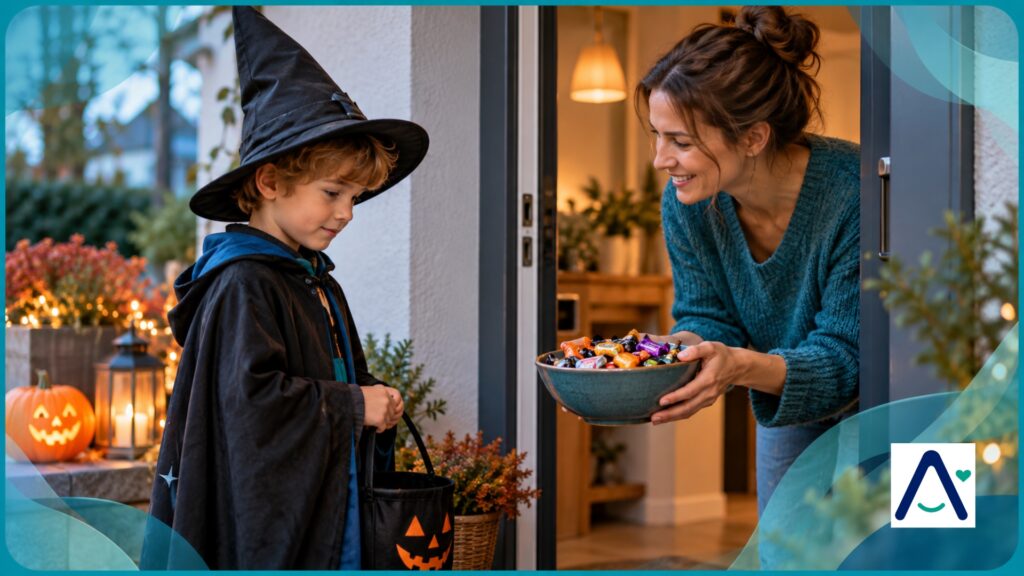
A child stands at a front door on Halloween, holding out their sweet bag and saying not a word. Some adults react with irritation and tell them to say “trick or treat” first. But for autistic children, even this brief encounter can be a great challenge. Shortly before Halloween 2026, American autism organisations are therefore drawing attention to a simple message. Children do not have to speak or make eye contact to be welcome at Halloween.
On social media, a special marking is being discussed at the same time. Blue Halloween buckets are meant to signal to others that a child is autistic and may communicate differently. The idea is controversial, however. While some families see it as a relief, others criticise that children should not have to disclose their diagnosis in order to be met with understanding.
Why Halloween can become difficult for autistic children
On 31 October, many children in costumes are once again out and about on the streets. They ring doorbells, meet strangers and collect sweets. For many this is an exciting experience. For some autistic children, however, numerous demands come together at once.
People in costumes suddenly look different from what they are used to. Decorations move unexpectedly, pumpkins flash and loud sounds come from some front gardens. Add to that unfamiliar houses, strange adults and the expectation of saying certain sentences.
The British National Autistic Society points out that such changes and sensory impressions can be overwhelming. However, not every autistic child experiences Halloween as stressful. Some love costumes, spooky decorations and the special atmosphere.
What matters is therefore what experiences a child wants to have themselves and what support they need for it. Our knowledge article on sensory overload in autism explains more about different reactions to sound, light and touch.
Not every child can or wants to speak at the front door
Collecting sweets follows a fixed social expectation. Children are supposed to ring the bell, say “trick or treat”, accept the sweets and then say thank you.
But not all children can manage this sequence without difficulty. Some autistic people communicate not at all or only to a limited extent through spoken language. Others can speak in principle but find no words in an unfamiliar or stressful situation.
A child can therefore hold out their bag in silence, point at sweets or use a communication device. This means neither that they are impolite nor that they do not understand the situation.
In its current Halloween recommendations, the Autism Society of Wisconsin stresses that children do not have to demonstrate any particular form of communication in order to take part. A child who does not make eye contact or does not audibly say thank you can also enjoy the encounter.
Why blue Halloween buckets are being discussed on social media
For several years, the idea has been spreading on American social media that autistic children use a blue bucket for collecting sweets on Halloween. The colour is meant to signal to people at the front door that a child may need more patience or a different form of communication.
The idea became known through posts by individual parents and was then widely shared. It is meant to avoid families having to explain again at every encounter why their child does not speak or reacts differently than expected.
However, it is not an official or internationally uniformly recognised sign for autism. The British fact-checking organisation Full Fact already pointed out in 2019 that the blue buckets are not an official marking of the autistic community.
In 2026, too, the topic remains controversial. Some families report that a visible marking gives them security. Others reject it because personal health information becomes public without need.
A blue bucket is not proof of autism
No diagnosis can be derived from the colour of a sweet bag. A child can use a blue bucket because they like the colour. Likewise, autistic children can use orange, green or completely different bags.
The expectation that autistic children need a special marking in order to receive consideration would therefore be problematic. The decision on using such a symbol should lie with those affected or their families and take the child’s wishes into account.
The discussion also shows a fundamental problem. People with invisible disabilities often have to explain their support needs before others accommodate them.
On Halloween, this hurdle can be avoided particularly easily. Anyone handing out sweets can treat children kindly regardless of their language, their eye contact or the colour of their bucket.
Teal pumpkins have a different meaning
To be distinguished from the blue Halloween buckets is a different initiative from the USA. In the so-called Teal Pumpkin Project, teal-coloured pumpkins are placed outside houses.
The project is supported by the American organisation Food Allergy Research & Education. Such a pumpkin signals that, alongside sweets, small non-food gifts are also offered.
The campaign is aimed in particular at children with food allergies. But it can also help families whose children do not want to or cannot eat certain foods.
The teal pumpkins thus mark an offer at the front door and not a child’s diagnosis. In Germany, however, this American symbol is not established across the board. Families should therefore not assume that its meaning is known everywhere.
What parents can prepare before Halloween
On 22 October 2026, the Autism Association of Australia published new recommendations for families. At the centre is the question of how children can take part in Halloween according to their own interests and needs.
It can help to go through the sequence together beforehand. Parents can show which houses will be visited, who lives there and what happens when the doorbell is rung. Photos, short explanations or a visual schedule can provide orientation.
A trial run with familiar people can also make sense. It lets you try out whether the child wants to ring the bell themselves, show a card or would rather be accompanied by a parent.
For non-speaking children, prepared communication cards can help. They can say, for example, “trick or treat” and “thank you”. Communication aids already in use can also be used.
The preparation should not serve to put a child under pressure, however. They do not have to master all the steps in order to be allowed to join in. We explain more about different forms of communication in our knowledge article on communication in everyday life in autism.
A Halloween costume can also be very simple
Some children love elaborate costumes. For others, masks, synthetic fabrics, make-up or tight costumes can be unpleasant. The National Autistic Society therefore recommends choosing clothing that is as comfortable as possible and letting the child decide.
A familiar T-shirt with a small costume accessory can be just as suitable as a full costume. A Halloween evening without a costume is also possible.
It is important to try clothes out beforehand. If a child does not want to wear a mask or wants to take a costume off after a short time, this should be accepted.
Parents can also think together about which sensory impressions might become difficult. Depending on need, ear defenders, a familiar object or an agreed place to withdraw to can help.
A few houses can be enough for a child
A Halloween evening does not have to consist of a long round through the neighbourhood. Some children only want to visit one or two familiar houses. Others only decide along the way whether they want to carry on.
The Autism Association of Australia therefore recommends short, manageable outings and planning that is as flexible as possible. A visit to known neighbours early in the evening can be more pleasant than a long round through crowded, dark streets.
Parents should agree beforehand how the child can communicate that they need a break or want to go home. This signal should be respected even if the planned round is not yet finished.
Road safety remains particularly important. Highly visible clothing, reflective elements and suitable accompaniment can help when children are out after dark.
How outings with autistic people can be prepared is explained in more detail in our article Out and about in everyday life and on journeys.
What neighbours can do differently on Halloween
The people who open their front door can also contribute to making Halloween accessible to more children. No special knowledge of autism is required for this.
If a child stands silently at the door, they can simply be offered a sweet. Adults do not have to insist on a spoken greeting, a thank you or eye contact.
It is equally helpful not to touch children without asking or to frighten them with especially loud noises. Moving decorations and suddenly triggered scare effects can be stressful for some children.
If you like, you can offer small alternatives such as stickers alongside sweets. This can help children who avoid certain foods or may not eat them because of allergies.
Above all, adults should not voice assumptions about a possible diagnosis. Reserved or unusual behaviour is no reason to ask a child about autism in front of others.
A Halloween evening at home is perfectly fine too
Some children do not want to go from house to house at all. They would rather watch a film, decorate their room or spend the evening with a familiar activity.
Others deliberately do not want to celebrate Halloween. That is an equally valid decision too.
The current recommendations of various autism organisations therefore stress that the child’s wishes and needs are more important than social expectations of a successful Halloween.
For families, this can also mean shaping the evening differently than originally planned. If a child is exhausted or feels uncomfortable, visiting further houses does not have to be forced.
Halloween shows how simple consideration can be
The discussion about blue sweet buckets makes clear how often children with invisible disabilities are measured against fixed social expectations. Yet dealing with them at the front door could be much simpler.
A child does not have to speak, make eye contact or disclose a diagnosis in order to be treated kindly. They are allowed to be happy about sweets even if they show their joy differently from other children.
For autistic people, even this natural courtesy can make a difference. Halloween thus offers not only an occasion for costumes and sweets, but also the chance to enable participation in society without unnecessary hurdles.
Sources
Autism Association of Australia. How to make Halloween easier for your autistic child. 22 October 2026.
Autism Society of Wisconsin. Halloween, Your Way, Making the Holiday Work for Your Child. October 2026.
National Autistic Society. Tips for an autism-friendly Halloween. 25 October 2023.
Full Fact. Blue trick or treating pumpkin buckets are not official symbols for the autistic community. Fact check of 24 October 2019.
Food Allergy Research & Education. FARE’s Teal Pumpkin Project Returns This Halloween Season. 22 September 2026.
Autism SA. Tips for an Autism-Friendly Halloween. Specialist information for families and the public.
Found a mistake?
If something is factually wrong, out of date or unclear, let us know. You do not have to give any personal details.