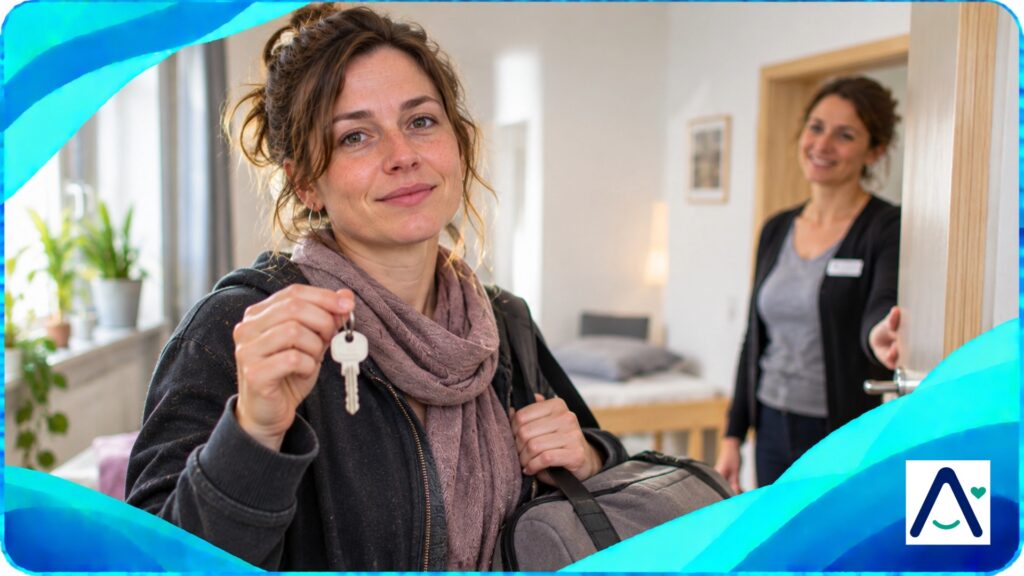
A free place in a women’s refuge can mean safety. For a woman with autism, it can also be decisive whether she can make contact in writing, whether routines are explained clearly and whether a quiet place to withdraw is available. Protection must be reachable and must fit the personal situation.
From 1 January 2027, this task becomes more binding for the German states. The states’ responsibility under the Violence Assistance Act (Gewalthilfegesetz) to ensure a needs-based support system then begins. The federal government has confirmed the timetable in a reply to a minor interpellation from the Left Party parliamentary group. The reply is dated 10 November 2026, the Bundestag report on it 16 November.
The states must ensure a needs-based provision
The responsibility covers protection and counselling services of sufficient scope and with appropriate geographical distribution. It therefore concerns both women’s refuges and specialist counselling centres. Planning must take different needs into account, including disabilities and the situation of children who are also affected.
The federal government stresses that needs-appropriate protection services should also reach women who are homeless or have no fixed home. The mandate is therefore not limited to women with a permanent address.
The law was already passed in 2025. The current reply does not announce a new reform but explains the forthcoming implementation of an existing rule.
The individual legal entitlement does not begin until 2032
The distinction between two dates matters for those affected. From January 2027, the states must ensure the needs-based support system. The new individual legal entitlement to protection and specialist counselling under the Violence Assistance Act, by contrast, does not come into force until 1 January 2032.
The 2027 deadline therefore does not yet give rise to an individual entitlement under this new rule to an immediately available place in a women’s refuge. Existing help and other protective rights are not affected.
The statutory ban on charging those affected contributions for protection, counselling or support services under the Violence Assistance Act also does not take effect until 2032. Until then, funding and possible personal contributions for a stay in a women’s refuge may be regulated differently depending on the situation and region. A counselling centre can help to clarify this.
Accessibility must also take communication and sensory load into account
Frauenhauskoordinierung, the national coordination body for women’s refuges, describes a lack of accessibility and limited staff resources as barriers to access. A disability can make additional support necessary that a facility cannot readily provide. The published figures concern women with various impairments. They do not allow any reliable statement on how many women with autism cannot find a suitable place of protection.
Even so, concrete requirements can be formulated for putting this into practice for autism. Ways of making contact in writing, clear information about the daily routine, enough time to reply and, as far as possible, low-stimulus rooms for conversations can help. If a woman needs assistance, it should be clarified how it can be continued at the place of protection.
Not every woman with autism needs the same adjustments. A calm or seemingly adapted manner also says little about how stressful a situation is experienced. Background on adaptation strategies is explained in our article on autism in women.
For facilities, this results in a practical task: to discuss the support need with the woman concerned and respect her decisions, rather than drawing conclusions about her abilities from the diagnosis.
Help is possible today
Women do not have to wait until 2027 or 2032 to seek support. Women’s refuges and specialist counselling centres are already working now. Whether a suitable place is free and which support can be offered has to be clarified in each individual case.
The “Violence against Women” helpline (Hilfetelefon “Gewalt gegen Frauen”) can be reached within Germany on 116 016 around the clock. Counselling is free of charge, anonymous and confidential. Relatives, supporters and professionals can also get advice. On request, the counsellors refer callers to local services.
Anyone who prefers to write can use the protected online counselling. The instant chat is available every day from 12 to 8 pm without registration. Registration is required for email counselling and for a chat appointment. Online counselling is provided in German.
In acute danger, the police are responsible on 110. If the person using violence has access to the phone or other devices, contact should if possible be made from a safe device. Even a confidential counselling service can leave traces in the call list or browser history.
What matters is protection that can actually be used
The new responsibility of the states is an important legal step. Whether it reaches women with autism better will become clear from concrete conditions. Are there suitable places, understandable counselling and support even where there is additional need for assistance?
A protection service fulfils its purpose only when a woman can reach it and stay safe there. The responsibility for this must not be passed on to those affected.
Sources and legal status
- Federal government. Reply to the minor interpellation on measures to prevent femicides, printed paper 21/9065, 10 November 2026, in particular replies to questions 10 and 16.
- German Bundestag. Protection services in women’s refuges, 16 November 2026.
- Violence Assistance Act of 24 February 2025, including the different provisions on entry into force.
- Federal Ministry for Women. Protection and counselling under the Violence Assistance Act.
- Frauenhauskoordinierung. Assessment of the Violence Assistance Act and evaluation of barriers to access, 2024.
- “Violence against Women” helpline. Telephone counselling and protected online counselling.
Legal and research status: 21 November 2026.
Found a mistake?
If something is factually wrong, out of date or unclear, let us know. You do not have to give any personal details.