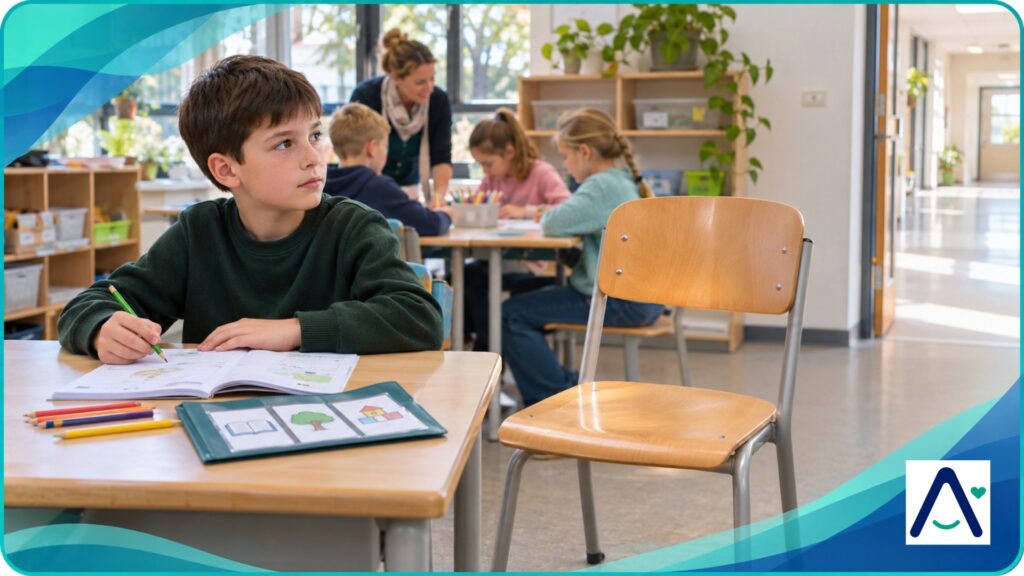

Almost seven out of ten children who started at a special needs school (Förderschule) in the 2026/2027 school year are boys. This is shown by new figures from the Federal Statistical Office. In primary schools, by contrast, the ratio of boys to girls is almost balanced. The clear differences raise questions about special educational support and school inclusion.
According to provisional figures, around 805,200 children started school in total. That was 6,000 fewer than the year before. The statistics were published on 11 November 2026. What the results mean for children with autism cannot, however, be read directly from the figures.
At special schools, 69 percent of school starters are boys
According to Destatis, 93 percent of all children starting school began their school career at a primary school. A further 3.6 percent started at special schools. Nationwide, that corresponds to around 29,000 children.
While boys made up 51 percent of school starters overall, their share at special schools was 69 percent. Girls accounted for only 31 percent there.
The difference is not a new development, however. In the 2024/2025 and 2025/2026 school years, the share of boys among children starting at special schools was also 69 percent.
The current data thus show a persistently unequal distribution. Why boys are started at special schools considerably more often cannot be explained from this.
What the figures say about children with autism
For families of children with autism, the results are of interest because school support often plays an important role. However, the current Destatis report does not record autism diagnoses.
The special educational needs school statistics also distinguish different areas of support such as learning, language or emotional and social development. These categories are not equivalent to medical diagnoses.
It would therefore be wrong to conclude that 69 percent of the children with autism at special schools are boys. Nor do the figures prove that boys need special educational support more often than girls.
What remains professionally relevant is the question of how support needs are identified and how school decisions are made. Our knowledge article on girls with autism in everyday school life explains why certain difficulties may be noticed later in girls.
Inclusion also depends on conditions at schools
The new figures touch on a broader debate about participation in school. The choice between a special school and a mainstream school depends not only on a child’s support needs. The services available and the general conditions also play a role.
A study by the German Institute for Human Rights published in 2026 shows this for North Rhine-Westphalia. Of 2,315 parents of children with disabilities surveyed, 91.4 percent wanted schools that sufficiently support learning together.
Among the surveyed parents of children at special schools, 68.8 percent would have preferred a mainstream school if conditions there had been better. These results refer to North Rhine-Westphalia and cannot simply be transferred to Germany as a whole.
Which types of school come into question and which legal differences exist is explained in our article on school types and inclusion in autism.
What the results mean for parents and schools
The choice of a suitable place of learning must be guided by the child’s individual needs. For children with autism, clear daily structures, adapted communication, lower-stimulus learning conditions or school support can help, for example.
What matters is which support is actually available and how the child can take part in lessons and social life. Our knowledge article on preparing for school entry with autism offers helpful suggestions.
The Destatis figures show a striking gender distribution at special schools that has been stable over several years. They answer neither the question of its causes nor which type of school is suitable for an individual child.
Additional information is therefore needed for the further discussion about inclusion. This includes the reasons for school decisions, the experiences of the children affected and the support actually available at mainstream schools.
Sources
Federal Statistical Office, 11 November 2026. Number of school starters in 2026 fell by 0.7 percent (German).
Federal Statistical Office, November 2025. School entry figures for the 2025/2026 school year (German).
Standing Conference of the Ministers of Education and Cultural Affairs (KMK). Special educational support in schools (German).
German Institute for Human Rights, 26 August 2026. Majority of parents in North Rhine-Westphalia want inclusive education (German).
Found a mistake?
If something is factually wrong, out of date or unclear, let us know. You do not have to give any personal details.