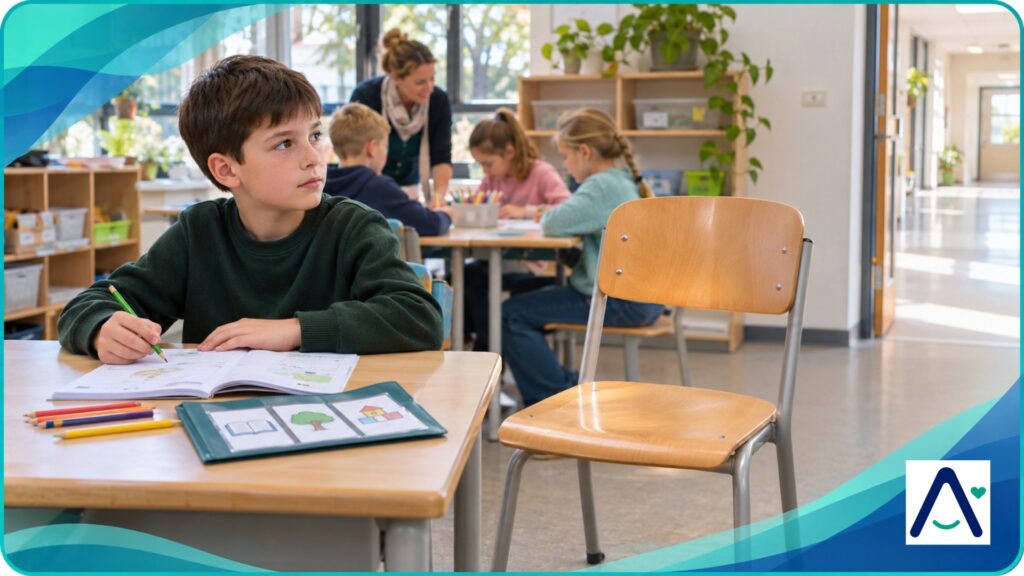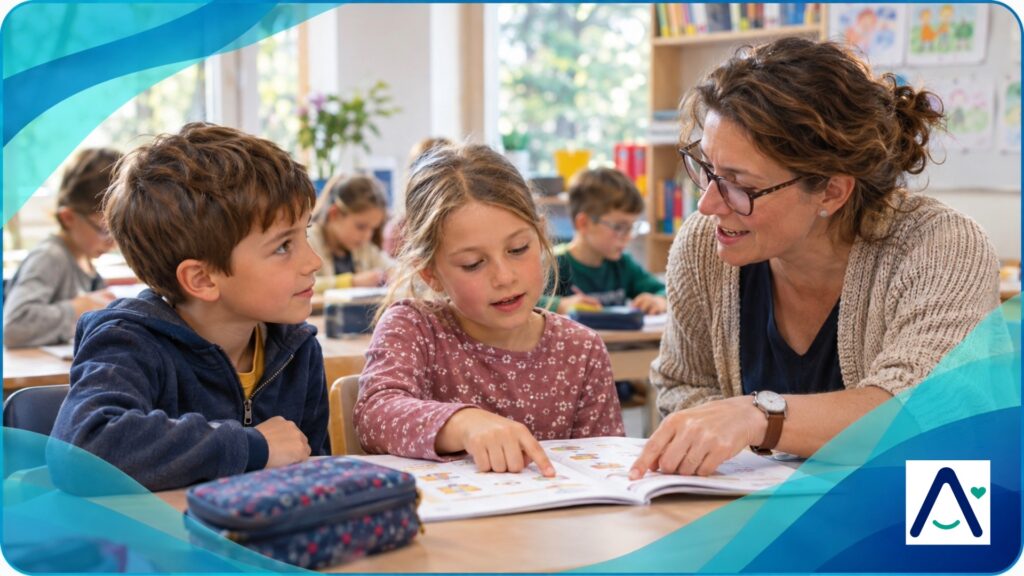

Understanding a child better, making shared situations more relaxed and staying in conversation with the parents. The training programme “Smooth Sailing” focuses on the relationship between teacher and child. A new pilot study delivers first encouraging results.
The study, published on 31 October 2026, covered 32 teachers and one child with autism each in US classes from kindergarten to second grade. It was assigned at random who received the programme immediately or only later.
Four weeks with exercises in the classroom
The programme combines eight online learning modules with three individual coaching conversations and exercises in everyday school life. The project description estimates around twelve to 15 hours over four weeks for this. Application in lessons comes on top of that. It is therefore an accompanied training in which the content is repeatedly tried out and discussed.
The focus is on building a sustainable relationship, knowledge about autism and cooperation with parents. The teachers practise shaping their interactions with the child more consciously and reviewing experiences together with a coach. A conversation with the parents is also part of the concept. The programme was developed with the involvement of teachers and people with autism.
More knowledge and better relationship ratings
After the training, the teachers rated their relationship with the participating child better than the comparison group did. Their knowledge of autism and their confidence in their own abilities also increased. These differences were still detectable after two months.
Among the children, advantages initially appeared, among other things, in the rated participation in lessons. After two months, however, this difference was no longer statistically reliable. There was also no statistically reliable advantage in social skills. A lasting improvement in everyday school life is therefore not demonstrated.
A small study with important limits
The results rest largely on assessments by the adults involved. The children’s perspective on the programme was not collected. The study was also small, not registered in advance and carried out by the development team. Larger, independent studies must test the findings. They cannot simply be transferred to other age groups and German schools.
A starting point for schools and parents
When choosing a training, it is therefore worth taking a close look at how it is built. Does it take up concrete classroom situations? Is there an opportunity to try things out and get feedback? Is parents’ knowledge included? These questions can help to check an offer for everyday usability. Our article on cooperation between parents and school offers suggestions for agreeing things together.
There are also offers in Germany. With INCLASS, the DIPF (Leibniz Institute for Research and Information in Education) provides a free online training for educational professionals. According to the institute, a full run-through takes about four hours; individual modules can be completed separately. INCLASS is a different programme. The results of the US pilot study must therefore not be used as proof of effectiveness for this offer.
Sources
- Blacher, J. et al. (31 October 2026). Improving Student-Teacher Relationships for Autistic Children: Pilot Randomized Controlled Trial of a Professional Development Program. Journal of Autism and Developmental Disorders.
- Smooth Sailing. Information for Teachers. Description of the programme, no publication date given.
- DIPF (13 March 2026). Well prepared for autism-sensitive teaching (German).
Found a mistake?
If something is factually wrong, out of date or unclear, let us know. You do not have to give any personal details.