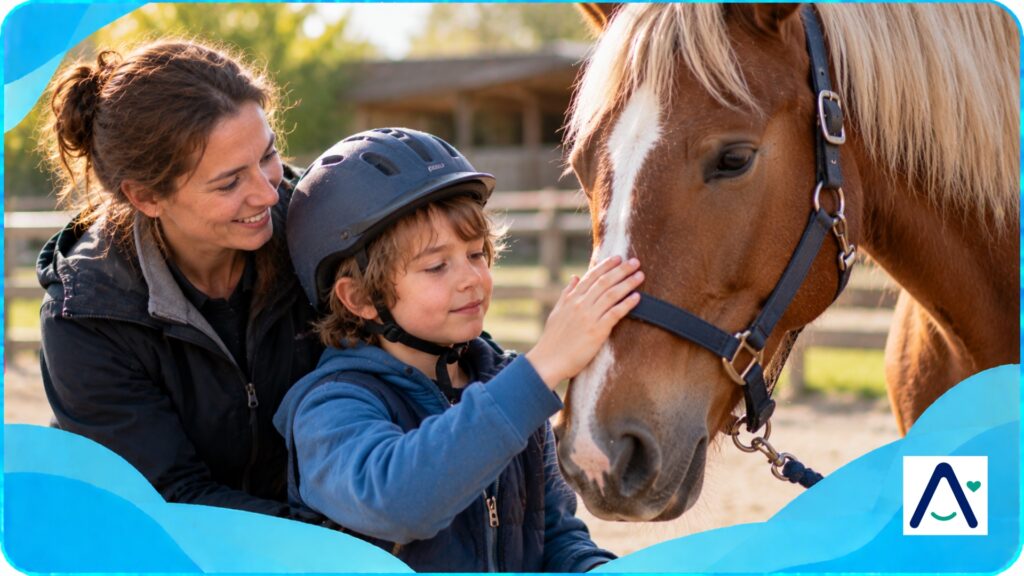
A child sits on a horse, feels its steady movements and concentrates on the next task. What looks like a leisure activity to outsiders can be part of targeted therapeutic support. Two new American studies now provide indications that horse-assisted programmes can help autistic children. The researchers found both changes in the body’s stress response and improvements in certain behavioural and emotional difficulties.
The results were published in October 2026 in the journals Journal of Autism and Developmental Disorders and Pediatrics. It is particularly interesting that the two studies answer different questions. While one study measured stress hormones in saliva, the other examined, among other things, hyperactivity, irritability and the regulation of emotions.
New study examines stress in 72 autistic children
A research team at Colorado State University studied 72 autistic children aged between six and eleven. The children were randomly assigned to two groups. One group received occupational therapy involving horses, the other occupational therapy in a conventional treatment room.
The programmes took place over ten weeks, once a week for an hour. In content, both groups dealt with perceiving and regulating emotions. In the horse group, the exercises were carried out while riding, while the comparison group worked on similar tasks in a practice.
The researchers examined saliva samples from the children at different points in time. They were particularly interested in cortisol and alpha-amylase. Both substances can provide indications of how the body reacts to demands and strain.
With horse contact, the stress hormone fell more
In both therapy groups, cortisol values fell over the course of individual sessions. In the children who worked with horses, however, this fall was more pronounced. Even 20 minutes after the end of the exercises, a statistically significant difference from the group with occupational therapy in the treatment room could be seen.
The researchers interpret this as an indication of a more favourable physical stress response during horse-assisted occupational therapy. At the same time, alpha-amylase rose during the exercises. This can point to increased physical activation, for example through attention, movement or excitement.
The combination of lower cortisol and temporarily raised alpha-amylase could mean that the children were attentive and engaged without at the same time showing a correspondingly strong stress response. However, feelings cannot be read clearly from such biomarkers.
It is also important that cortisol values before the appointments did not fall permanently over the ten weeks. The study thus mainly shows a difference during and immediately after the sessions. A long-term reduction in the everyday stress level has not been demonstrated.
Second study finds improvements in hyperactivity
A further study by the University of Colorado Anschutz was published on 9 October 2026 in the journal Pediatrics. For the randomised study, 236 autistic children and adolescents aged between six and 16 were enrolled. All additionally had at least one psychiatric diagnosis.
The participants were assigned to different programmes. One group took part in therapeutic horseback riding, another took part in structured activities on the theme of horses but without direct contact with horses. A further group served at first as a waiting-list comparison.
The reported analysis included 169 participants who had completed at least one corresponding session or the comparison period. Compared with the waiting-list group, both therapeutic riding and the activities without horse contact showed improvements in irritability and hyperactivity.
Positive changes were also found in emotional regulation and certain social behaviours. The improvements in hyperactivity were stronger in the riding group than in the group without direct contact with horses.
Not all positive results were due to riding
A particularly interesting finding concerns the group that dealt with horses without actually riding. The children there worked with horse-related activities and materials. In this group too, several behavioural areas examined improved compared with the waiting-list control.
This suggests that movement on the horse may not be the only thing that plays a role. A reliable routine, shared activities, motivating tasks or engaging with an interesting topic could also have contributed to the results.
Which individual components are particularly helpful for which children remains open, however. The results do not allow the statement that every engagement with horses automatically has a therapeutic effect.
Why horses can be interesting for some autistic children
Horses react to movements, body language and how they are handled. With suitably designed programmes, children can learn to pay attention to changes, adapt their own actions and concentrate on a shared activity. The steady movements of riding can also convey particular sensory impressions.
For some autistic people, such experiences can be pleasant and motivating. Others experience smells, sounds, touch or unpredictable movements as stressful, by contrast. A positive effect cannot therefore be derived from the diagnosis alone.
With sensory differences in particular, it is important to take the individual child’s reactions into account. Our knowledge article on sensory processing and perception in autism explains more about this.
What the results mean for parents
The two studies provide indications that carefully designed horse-assisted programmes could be helpful for certain autistic children. They do not mean, however, that riding therapy is better than other forms of support in general.
In the study on the physical stress response, the number of participants was limited. Of 72 children assigned, 56 completed the respective intervention. In addition, the dropout rates of the two groups differed, which makes interpretation harder still.
In the larger study, what was mainly evaluated was information from caregivers on changes in behaviour. Such observations are important but can be influenced by expectations. The caregivers knew which programme their child had taken part in.
The larger study also expressly examined children and adolescents with autism and additional psychiatric diagnoses. The results therefore cannot simply be transferred to all autistic people.
How parents can recognise a suitable programme
Anyone thinking about therapeutic riding or horse-assisted support should first clarify what concrete goal is to be achieved. This can be, for example, coping with strain, taking part in leisure activities or promoting certain practical everyday skills.
Qualified professionals, suitable animals and a safe environment are important. This includes appropriate supervision, suitable protective equipment and the option of interrupting the session at any time. The welfare of the horses must also be taken into account.
A child should not be pushed to ride if they are afraid or experience the situation as stressful. A first getting-to-know-you without riding can help to take their own interests and needs into account.
Not every leisure activity with horses is a medical therapy. If a therapeutic benefit is promised, parents should ask about the qualifications, the objective and the basis for such claims. Further orientation is provided by our knowledge article on autism-specific therapy and support.
Does health insurance cover the cost of riding therapy?
The American studies do not automatically mean that horse-assisted programmes are paid for by statutory health insurers in Germany. Funding depends, among other things, on the type of service, its objective and the responsible funding body.
The Federal Joint Committee (Gemeinsamer Bundesausschuss) had already decided in 2006 not to include physiotherapeutic treatment on the horse, so-called hippotherapy, in the benefits catalogue of statutory health insurance. This decision referred expressly to hippotherapy and not to all forms of therapeutic riding.
For other horse-assisted programmes, it therefore has to be checked separately whether and on what basis funding is possible. Before registering, parents should ask about the costs and, where appropriate, find out from the responsible funding body or an independent counselling service.
Joy and self-determination are also important
The question of the benefit of such programmes should not be reduced to test results or changes in behaviour alone. The joy of an activity, the experience of self-efficacy and the chance to pursue one’s own interests can also be significant for autistic children.
A child does not have to be constantly given therapeutic support. Leisure time may also simply be leisure time. Whether riding, swimming, music or another activity, what matters is that the activity suits the child’s wishes and needs.
How suitable leisure activities can be chosen is explained in our article on leisure and interests in autism.
Further research is to show which children horses help most
The two new publications strengthen the scientific basis for horse-assisted programmes. The measurement of physical stress responses in particular adds to earlier studies that relied mainly on observations and questionnaires.
Important questions nevertheless remain open. It is not yet sufficiently clear how long possible improvements last, which children benefit particularly and whether comparable results can also be achieved with other exercise or leisure programmes.
For families, the findings are therefore interesting additional orientation but not a general therapy mandate. The decision for or against a programme should be guided by the child’s needs, interests and limits of tolerance.
Sources
Rankins, E. M. et al. Effects of Incorporating Horses into Occupational Therapy on Adrenocortical and Sympathetic Nervous System Reactivity and Regulation in Autistic Children. Journal of Autism and Developmental Disorders, 10 October 2026.
Gabriels, R. L. et al. Therapeutic Horseback Riding for Youth With Autism and Psychiatric Comorbidities. Pediatrics, 9 October 2026.
Colorado State University. Horse-assisted therapy linked to lower stress in children with autism. Research news of 19 October 2026.
University of Colorado Anschutz. Horse-Based Activities May Help Autistic Youth With Behavioral and Emotional Challenges. 9 October 2026.
Federal Joint Committee (Gemeinsamer Bundesausschuss). No evidence of an additional benefit of physiotherapeutic riding therapy (in German). Decision of 20 June 2006.
Found a mistake?
If something is factually wrong, out of date or unclear, let us know. You do not have to give any personal details.