
In brief
Aids can make everyday life easier, for example ear defenders in noise, pictures or videos for orientation and digital applications. The studies on them are mostly small and short. In a pilot study, behaviour linked to sounds improved markedly with ear defenders, and with noise-cancelling earbuds attention and listening in lessons improved in a small study. Which aid fits is individual; trying out and agreement with professionals help.
Ear protection, defenders and headphones
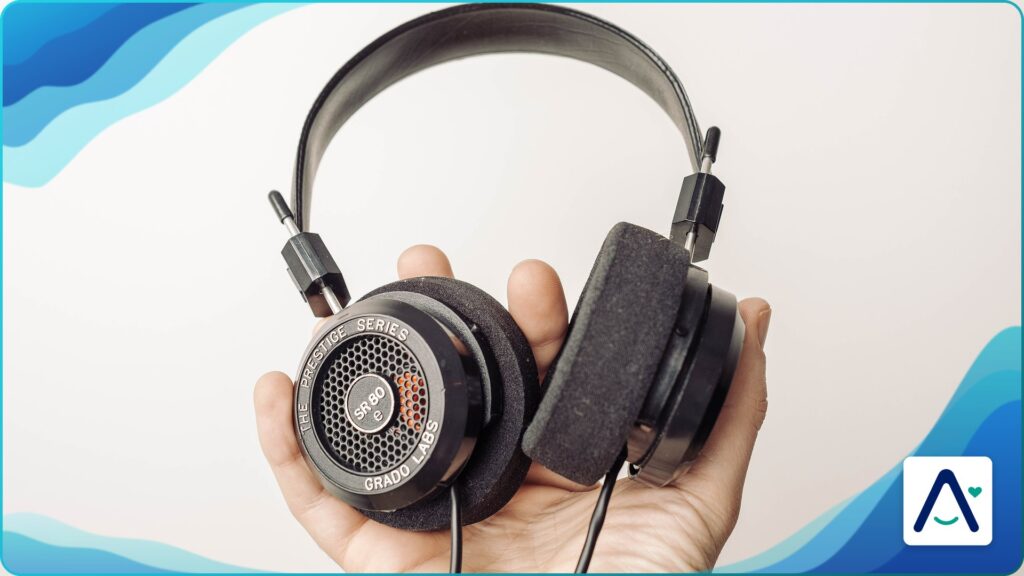
In a pilot study with 21 children (aged 4 to 16), Ikuta and colleagues tested ear defenders and noise-cancelling headphones. After two weeks without aids, the children used both for two weeks each in random order. Parents or teachers rated behaviour with sounds. Four children refused both devices. In the ear defender phase, goal attainment improved significantly compared with the phase without aids. With the noise-cancelling headphones there were improvements in five children but no significant difference. The authors conclude that ear defenders can be helpful and noise-cancelling headphones perhaps for children who are not troubled by human voices. It is a pilot study with short wearing time. [2]
Noise-cancelling earbuds in lessons
Zanin and colleagues tested Bluetooth noise-cancelling earbuds in 13 children (aged 6 to 13). Understanding speech in noise was poorer in the children than in peers without autism and did not change with the earbuds. Auditory attention, by contrast, improved markedly. After two weeks of use, teachers rated listening and communication in lessons clearly better. The group was small and the test phase short. The examiners and teachers knew who wore the device (not blinded). The authors see the earbuds as a possible alternative to microphone systems that is less conspicuous. [5] On dealing with stimuli the article Recognising and preventing sensory overload informs.
Visualisation, pictures, schedules and videos
Picture aids are often used in practice and support. For dental care, two evaluations summarised what they achieve. A meta-analysis of 23 studies found a consistent tendency towards better dental care and better cooperation at the dentist but no conclusive evidence. [1] A more recent one with 27 studies found improvements in plaque and gums, especially with videos. [4] More on implementation in the articles Structuring and visualisation in practice and Visiting the dentist and dental health.
Digital aids and assistive technology
A systematic review of 18 studies on assistive technology in people with autism or intellectual disability reports benefits for social participation and independence in everyday life. Virtual reality, apps and interactive software improved everyday skills, communication and social interaction in the studies. The authors stress that common everyday devices can also help. As limits they name very different studies, a fifth being pilot studies, some prototypes and inconsistently described participants. [3] To put support services into context, the article Which support helps? Overview and classification helps.
How you can try things out
From the studies it follows that not every child accepts every device. Four of 21 refused both devices. Short trial periods and feedback from parents, teachers and the person themselves help to judge whether something is useful. [2] [5]
As a note from the editorial team without a study finding, you should introduce aids gradually rather than force them, note safety aspects and decide together when they are used. An example of a safety aspect is road traffic with noise cancelling. On costs and prescription of aids, the articles Remedies and aids on prescription and Funding autism therapy inform.
What we know and what is open
What we know. Ear defenders and noise-cancelling earbuds showed benefits for noise strain and attention in small studies. Picture aids and videos support in individual areas. [2] [5] [4]
Open.
- The studies are small, short and in part not blinded. Long-term effects and benefit in everyday life are unknown. [2] [5]
- Which aid suits whom. There are hardly any comparisons between devices or groups. [2]
- The studies on assistive technology are heterogeneous and in part prototypes. [3]
- For adults and for other aids, for example weighted blankets, no sources were evaluated.
You might also be interested in
- Recognising and preventing sensory overload
- Structuring and visualisation in practice
- Remedies and aids on prescription
- Dentist visits and dental health
- TEACCH and structured support
Sources and literature
- Balian A, Cirio S, Salerno C, Wolf TG, Campus G, Cagetti MG: Is Visual Pedagogy Effective in Improving Cooperation towards Oral Hygiene and Dental Care in Children with Autism Spectrum Disorder? A Systematic Review and Meta-Analysis. International Journal of Environmental Research and Public Health 2021;18(2):789. https://doi.org/10.3390/ijerph18020789 (frei lesbar, CC BY) – Systematic review with meta-analysis (23 studies)
- Ikuta N, Iwanaga R, Tokunaga A, Nakane H, Tanaka K, Tanaka G: Effectiveness of Earmuffs and Noise-cancelling Headphones for Coping with Hyper-reactivity to Auditory Stimuli in Children with Autism Spectrum Disorder: A Preliminary Study. Hong Kong Journal of Occupational Therapy 2016;28(1):24-32. https://doi.org/10.1016/j.hkjot.2016.09.001 (frei lesbar, CC BY-NC-ND) – Pilot study (21 children)
- Klavina A, Pérez-Fuster P, Daems J, Lyhne CN, Dervishi E, Pajalic Z, et al.: The use of assistive technology to promote practical skills in persons with autism spectrum disorder and intellectual disabilities: A systematic review. DIGITAL HEALTH 2024;10:20552076241281260. https://doi.org/10.1177/20552076241281260 (frei lesbar, CC BY-NC) – Systematic review (18 studies)
- Rajaei I, Babaei A, Djalalinia S, Qorbani M: Oral Health Interventions in Children With Autism Spectrum Disorder: A Systematic Review and Meta‐Analysis of Interventional Studies. Clinical and Experimental Dental Research 2025;11(6):e70258. https://doi.org/10.1002/cre2.70258 (frei lesbar, CC BY; online 01.12.2025) – Systematic review with meta-analysis (27 studies)
- Zanin J, Tomlin D, Rance G: Effectiveness of Noise Cancelling Earbuds in Reducing Hearing and Auditory Attention Deficits in Children with Autism. Journal of Clinical Medicine 2024;13(16):4786. https://doi.org/10.3390/jcm13164786 (frei lesbar, CC BY; online 14.08.2024) – Study (13 children)
You might also be interested in
Knowledge articleTherapies & support
Augmentative and alternative communication in autism: picture cards, devices and signs
Knowledge articleTherapies & support
TEACCH and structured support
Knowledge articleTherapies & support
Music therapy in autism: what research shows
Knowledge articleTherapies & support
Is autism curable? What support and therapy can achieve
Found a mistake?
If something is factually wrong, out of date or unclear, let us know. You do not have to give any personal details.